All posts by Debbie Sears

Retaining Top Talent With Benefits Employees Need & Want…

As I am invited to visit with small and large employers, I am a good listener. What are the ages, wants, budgets and needs of the employees? The employees make the employer successful, so it is ultimate that we consider every aspect of this puzzle. In the end, the numbers will tell the story.

The employer and I begin with some preliminary strategic ideas to contain the skyrocketing costs. When I say that, I mean the premiums and the out-of-pocket expenses. The employees and their families are paying more than ever before as a result of the realities of healthcare in our country.

There are three points that I would like to focus on for your consideration:

The networks of providers that we can access are shrinking along with the formularies on pharmacy items being narrowed. Some plans are leaving families with an excess of 40% of the medical costs. The average outlay is over $11,500, with an approximate $4,500 being out-of-pocket expenses. This illustrates a consistent increase of about $1,000 per year for the last several years. So, you may ask yourself, “How does the rising cost of care and smaller networks affect me?”. Nearly one third of patients are referred to specialists each year. The primary care physician is referring more than ever, in part due to liability. However, 50% of those referrals are out of network. So, the end result is rising premiums, smaller networks and high out-of-pocket costs that are a burden for most employees. I take extra consideration when suggesting network choices based on the known demographics of the group. It is prudent to offer choices, so that there are appropriate network options for all.

Foregoing care drives even higher costs for the family and the employer-provided medical plan. I encourage high-deductible health plans as a strong option for lower premiums and tax incentives combined with the idea that employees would be better consumers. The risk is that families will forego care, with a noted 55% reduction in office visits. This means that they are skipping both appropriate and inappropriate care. Missing an early diagnosis of a major health issue or failing to maintain an existing condition lands folks in the ER. With a plan like this in place, I take extra steps to provide the tools and education for them to enjoy the benefits of this option. This is a great choice, but some employees would be better off with different choices.

A large contributing factor of the out-of-pocket expense is the pharmacy utilization. The price increases on prescription drugs is amazingly high and disproportionate. There is an increasing use of specialty drugs which is the fastest-growing component in any medical plan. Most people don’t feel like they have options when it comes to this topic. Removing this benefit from plans to save premium, sometimes proves to be a mistake. I take extra steps to educate your employees to uncover more cost-effective options.

I cannot encourage employers enough to implement health incentives, wellness and fitness programs, tips, blogs, or newsletters. This is important enough that mid-sized to large employer groups are investing in employees dedicated and focused on nothing other than this. What a great way to attract and retain employees. This is a win-win. Investing in family’s health (the bread winner in some cases), the productivity of the employee for the company, and the personal rewards, make a difference.

With the points above being major issues, we offer you 40 years of knowledge and expertise to guide you to wiser decisions. Information is free, but experience is necessary for proper implementation.  Please call or email me for an appointment. My consultations are free.

I do not expect an employer or the employees to navigate an industry alone in which they are not trained, experienced or proficient. This industry has also experienced more change, complexities and regulations that ever before.

We are proud to say that our clients have made us successful. One hundred percent of my business is referral. I owe a deep appreciation for the professional confidence that has been placed in me to recommend coverage that is affordable and appropriate for your employees and their family’s needs.

Please visit my Facebook page – Sears Insurance – for weekly blogs and monthly newsletters. If you enjoy what you see, feel free to like us! We are members of the Better Business Bureau and recognized in the industry as Top Producers for decades.

Please visit my site at www.searsinsurance.com to learn more about what we can offer.

CMS Announces Changes to Short-Term Plans

CMS announced some long anticipated new rules surrounding of Short Term Limited Duration health plans.
Today’s rule provides consumers with more affordable options for health coverage. They will now have the ability to purchase short-term, limited-duration insurance policies that:

  • Are less than 12 months;
  • Contain important language to help them understand the coverage they are getting; and
  • May be renewed for up to 36 months.

Short Term Limited Duration plans are a good fit for many people in certain situations. We work with three major carriers offering Short Term products in many states, including UnitedHealthcare, National General and IHC. Medica will be releasing short term policies for sale in some states starting later this month.

Guaranteed, Fixed Annuities

As you look at your investment allocations, what is happening in the marketplace and in your own personal life, one product that is extremely popular is a guaranteed, fixed annuity.

These can be IRAs, 401(k) rollovers, or they can be non-qualified. We work with only the highest rated insurance companies and try to safeguard against the volatility of the stock market. If you were fortunate enough to ride the market up to its acclaimed, unprecedented high, wonderful. But, the adage, what goes up, must come down, will happen at some point.

This is not a scary thing. Our corporate returns are good, unemployment is down, but common sense tells us that there will be a market correction. If we are at a high, it only makes sense that, buy low and sell high, that you should be reallocating funds. At some point, gambling and speculation should be minimized for your own protection.

I have placed a huge number of clients’ hard-earned dollars in fixed, tax-deferred annuities very recently. The quoting process is easy. We look at the big picture, we discuss your budgetary needs and wants and your comfort level with everything you’re doing. If the numbers look favorable to you, you tell us how much you want to safeguard, and we start the process.

For instance, EMC National Life Company in Des Moines, over 100 years strong and highly rated, is offering a guaranteed principal, fixed annuity, tax-deferred rate of 4.2%. This is a very strong indicator that their financial forecast is in tune with what I just explained.

Life Insurance: A Gift Fit For A Grandchild

You may think that life insurance and grandchildren is a strange topic but let me explain. I’m at the point in my life where my children are raised and married, and I have accrued some money. How do I get money from myself to Generation 2 or Generation 3 in an efficient manner and at a maximum potential, factoring in obstacles such as probate, taxation, maximizing the money I have to invest and/or pass on?

Have you ever thought about this option? If I take a chunk and drop it into a life insurance policy, the younger my grandchildren are when I do this, the better. Then when my demise happens, they get more return on the investment immediately, without tax and without probate. If this happens and they’re still young, it goes into a trust for them. If they’re young adults and you want them to be able to use this at their own discretion, we structure the beneficiary per your wishers. If life changes, you are the owner of the contract and you can change the beneficiary status as needed. If you find it necessary to cash this, that is always an option as well.

I found a blog on this subject for your reading. Call me, quoting is free, and you may look at this from a different perspective.

Life insurance: A gift fit for a grandchild

By Tyson Dailey

Life insurance can be an appropriate and thoughtful gift for a child.

When you think about all the things you want to purchase for your grandchild, life insurance would likely be near the bottom of the list. While it may not be the most exotic purchase, by the end of this blog I hope life insurance would be up for consideration. Life Insurance for a child or grandchild offers three important advantages: it’s inexpensive; it provides protection for the unexpected; and certain types of life insurance could help protect your child’s or grandchild’s insurability.

First, life insurance is inexpensive. The way life insurance works is that the younger and healthier you are, the less the coverage will cost. Life insurance premiums are based on life expectancies and risk factors. Risk factors would include things that could adversely affect life expectancy, for example, health issues; habits like smoking or sky diving; and family history.

Let’s compare an 18-year-old nonsmoker with a 40-year-old smoker with high blood pressure and heart issues. The life insurance company would see the 18-year-old as a better risk based on age and the other risk factors (smoking and health), so the same coverage would cost less for the 18-year-old.

Second, life insurance’s main purpose is to provide a tax-free death benefit. I know it’s not a pleasant thought, so we will not dwell on it too much, but answer this question: Would it be better to have a tax-free benefit or use credit cards or a loan to pay for final expenses?

Finally, depending on the product purchased, you could protect your child’s or grandchild’s insurability.

As a parent or grandparent, you have a couple of options available for your child or grandchild’s insurability. First is term life insurance, which would provide coverage for a fixed number of years. A term policy could be converted later for up to the original face amount to a permanent form of life insurance without proof of insurability.

The other option would be a permanent life policy, which would be more expensive; however, it could offer a major advantage. Permanent forms of insurance can offer an insurability rider that allows purchasing additional coverage, without the proof of insurability. This protects your child or grandchild in case they develop a medical condition, making coverage more expensive or unavailable down the road. Just as insurance is more expensive as you age, some medical conditions make life insurance unobtainable.

Regardless of the type of coverage you select, purchasing life insurance for a child or grandchild is not a bad idea. The type, coverage amount and contract structure would vary based on each individual situation, and your agent can help you evaluate your options.

Disability Income Protection

Disability income protection is a coverage that is overlooked or there is not enough emphasis put on this important subject. When I consult with employers or with individuals, I look at the big picture. There are so many insurances that are all good and needed, but the question becomes, I think I could be insurance poor.

However, when I’m doing a consultation, I assess needs, wants, the budget and proportionately make insurance suggestions accordingly. I never leave out disability income protection. We can insure everything and more, but our lifeline to all these “things” we are insuring are tied to our income. Our home, our cars, our children, families, benefits, etc., are usually tied to our ability to pay. Disability, illnesses and accidents are not scheduled. Life rolls along, everything’s good and then something happens. The picture changes quickly if the income is impaired or goes away. Do your loved ones and yourself due diligence in having your entire package reviewed frequently as your life and your needs continue to evolve through our life’s journey.

We have a real gem in our State…Easter Seals Iowa. I have included some verbiage from that came to me from Allison Piazza, Events and Volunteer Coordinator, for Easter Seals Iowa and Camp Sunnyside explaining briefly how this money is spent. We also have two videos that came from Allison.

The insurer we feel does the best job with disability income protection is Principal, who is also Iowa-based. I have some information and a YouTube video from them as well. Please call me for a free analysis and let’s make sure you and your family are able to continue the lifestyle you enjoy when something unexpected comes your way.

http://www.easterseals.com/ia/get-involved/events/sunnyside-regatta.html

Easter Seals Iowa is a disability service provider, serving Iowans for over 90 years.  They help people in their homes, in the community, with employment, on the farm and in school.  Our services mean a child gets to experience camp for the first time, a young woman has helping to find and maintaining employment, a mom gets a much-needed break from care giving for her child with a disability, knowing her child is well cared for.  All money raised stays right here in Iowa and 93 cents of every dollar raised goes directly to services.  Our story is best told by the people we serve, like these two moms who share what our services have meant for their child, their families and for them as a mother.

Charlie’s story: https://youtu.be/EFFN6xtVeI0

Liz Hamer: https://youtu.be/nU2IT9HHiO8 

Principal Insurance Video https://www.youtube.com/watch?v=fiEHUjIA-pM

What Are the Different Types of Life Insurance?

We always attempt to get you factual and useful information as an educational tool prior to you making decisions on any of your insurances. Consumers Advocate.org is credible and non-biased towards any particular company or product. In this article, they define the different types of life insurance. Life changes, our needs change, our wants change and so does our budget over time. Younger families need life insurance to protect their assets, their debts, their children and ongoing needs. Older folks who have already met their obligations with children out of the home, debts reduced, often use life insurance to transfer wealth from one generation to the next without time delays, legal expenses and delays, probate expenses and delays, etc.

Term vs. Permanent

All life insurance falls under two basic categories, term life and permanent life. Term life covers you for a set period of time, while permanent life, covers you regardless of when you die. Both kinds have several subclassifications.

When you throw in customized riders — additional a la carte benefits at additional cost — and standard individual policy features that differ from company to company, you get a dizzying array of possibilities.

Term Life Insurance

Term life covers you for a predetermined period of time — commonly 10, 20 or 30 years. As such, of the two main types of insurance, term is less expensive premium wise. This type of life insurance is specifically geared toward providing for your loved ones in the event of an untimely death.

People who buy term life usually select a timespan that will cover the family until such time as the children are out of school and financially independent. Other considerations may include mortgage payments, debts, and income replacement.

Term is further divided into level term and decreasing term. Level term pays out the same amount regardless of when the insured dies, within the confines of the term. Decreasing term’s death payout decreases as the policy ages.

Some term policies are renewable, and some are able to convert into permanent. Some offer a ‘return of premium’ option, which will return the invested funds at the conclusion of the term. Unfortunately, these types of policies have higher premiums.

A policy’s monthly premium is calculated at purchase, and is dependent upon one’s age and health at that time. Generally speaking, however, companies will not insure a term that lasts beyond the policy holder’s eightieth birthday.

Whole Life Insurance

Whole life, or permanent life, pays out no matter what age you live to. Monthly premiums are fixed, and are usually a lot higher. To ensure premiums remain in place, companies generally inflate the premium costs in earlier years. This is done in order to compensate for the possibility of a long-lived policyholder. As your cash value increases, you have the option to borrow against it, surrender the policy for a payout, or collect dividends on it.

There are several types of whole life:

  • Universal Life
  • Survivorship
  • Guaranteed Acceptance

Universal Life

With universal life insurance, a policyholder can transfer money between the insurance and savings components. It allows the flexibility of being able to use savings to pay the premium in the event the return on the savings is small at a given time, or the insured has run into financial difficulty.

There are two variants of universal life:

  • Indexed Universal
  • Variable Universal

Indexed Universal

Indexed Universal policies allow the insured to divert funds into equity index accounts. Put simply, this allows policyholders to allocate a portion of their policy dollars for investments. The money earned is not taxed until payout.

Variable Universal

Variable Universal life insurance policies generate a cash value that increases over time, which is meant to be invested. Through this investment component, this type of permanent life insurance functions similarly to mutual fund.

Survivorship

As opposed to other life insurance variants, survivorship policies cover two individuals within one monthly premium payment. Upon the death of the first policyholder, however, no benefit is paid. It will not be disseminated until such time as the second policyholder is deceased. This option is geared toward married couples.

Guaranteed Acceptance

Guaranteed Acceptance life insurance is a policy type that helps those to cover their final expenses without requiring a medical exam. With such a guarantee, this variant of permanent life insurance is great for those with pre-existing conditions.

In short, where term life insurance indicates a set span of time, permanent life insurance is forever and builds cash value. All the other permutations of permanent are defined by what you are allowed to do with that cash value. For more information, Sears Insurance would be more than happy to assist.

Did You Know That You Still Need to Have Health Insurance in 2018?

There has been a lot of excitement over the repeal of the Affordable Care Act (ACA) provision that requires most Americans to have health insurance; many people are confused about whether the mandate is still in effect this year.

The insurance mandate has been removed, but the repeal doesn’t take effect until 2019. The scrapping of the requirement was part of the new tax law President Trump signed in December.

A recent Kaiser Family Foundation Health Tracking Poll found that 40 percent of those surveyed did not know that the health insurance mandate has been repealed. Some 21 percent were aware it has been removed but mistakenly thought that it took effect immediately and that they don’t have to have insurance this year.

Not having health insurance this year will cost you: The penalty is $695 per adult and $347.50 per child for a maximum of $2,085 per family, or 2.5 percent of the household income, whichever is greater. The dollar amount for the 2018 penalty may change because it’s subject to an increase for inflation. If you owe a penalty, you’ll pay it when
you file your income tax return.

Taxpayers can get an exemption from the insurance requirement if, for example, they can show they can’t afford the coverage; that they experienced a personal hardship, such as homelessness, a death in the family, or unpaid medical bills; or they live in a state that did not expand Medicaid.

The Internal Revenue Service has created an Affordable Care Act Estimator Tool, which can assess your potential penalty – https://www.irs.gov/affordable-care-act/individuals-and-families/calculating-an-individual-shared-responsibility-payment

The IRS announced last year that for the first time it will not process any electronically filed tax return that doesn’t include proof of health insurance in 2017. Paper returns could also be held up and refunds delayed. Employers and government health insurance programs had until March 2 to send taxpayers the 1095 forms that provide evidence o health insurance.

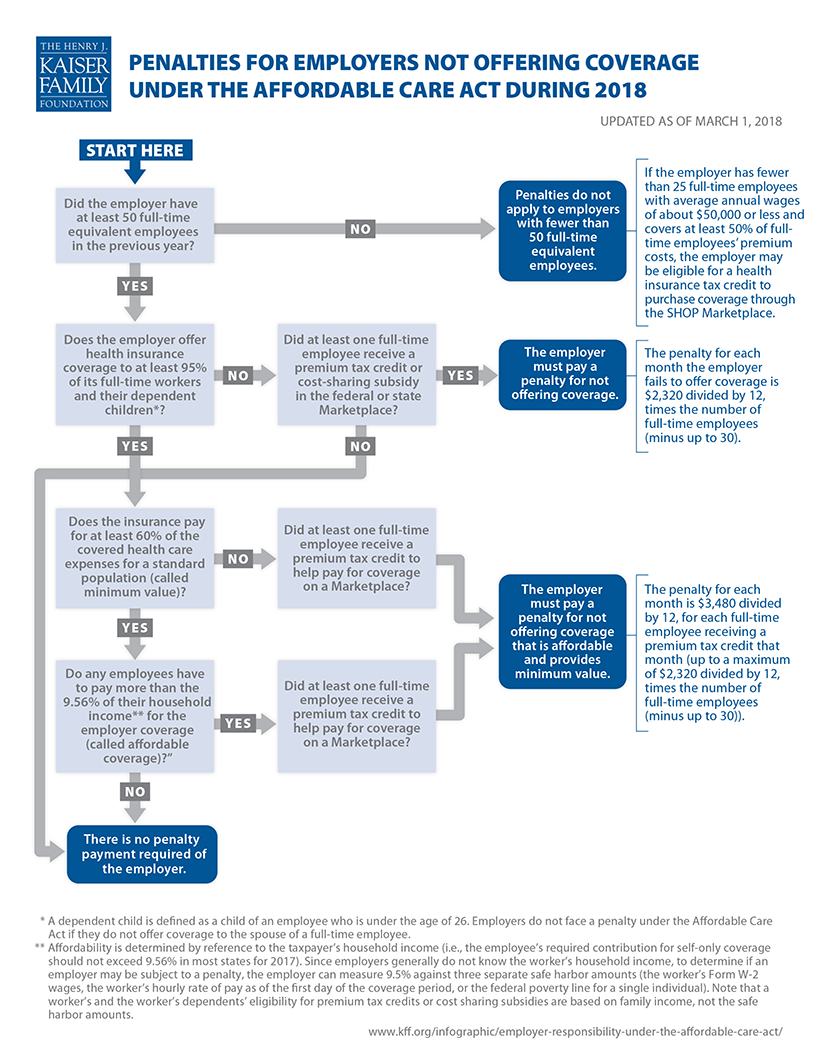
The Affordable Care Act does not require businesses to provide health benefits to their workers, but applicable large employers may face penalties if they don’t make affordable coverage available. The employer shared responsibility provision of the Affordable Care Act penalizes employers who either do not offer coverage or do not offer coverage that meets minimum value and affordability standards. These penalties apply to firms with 50 or more full-time equivalent employees. This flowchart illustrates how those employer responsibilities work.

Memorial Day Greetings

Memorial Day each year is a time of remembrance for the Veterans that have given us our freedom. Our loved ones that are in a better place and a time for family and friends to gather. It’s almost like the opening day of Summer! I’ve grabbed an article that I think is a fun one from the Farmer’s Almanac founded in 1872. This has all kinds of fun things, traditions, history, and more.

I thought you would find this a fun idea off the topic of insurance, but please keep in mind, we’ve got unfinished business with your insurance needs. Our consultations and quotes are free. Check out our blogs, e-newsletters and website and give us call.


Meet The Voices

Please catch this quick video sponsored by Principal regarding disability income protection. The statistics speak for themselves on the increase in disability in America. If you would happen to be one of the unfortunate ones, please know how important and how inexpensive (approximately 1% of your income) the cost of insurance really is.

For your insurance portfolio to be complete, the key is proportionate. The list of insurances we all need and pay for seems overwhelming, but if everything is proportionate to your needs and your budget and your income, you will find that you can cover all bases at a lesser cost than you might suspect. You owe it to yourself and your loved ones to at least look at the big picture. My quoting is free, please feel free to give us a call.

https://youtu.be/EFVHXenMUOk

Long-Term Disability Policy

Here is a short video on why long-term disability insurance is important. Responsible people have a longer list than they might realize that they take care of without mention. However, if your income would be impaired, whether it be short-term or long-term or if even indefinitely, this would affect yourself and many others. Our income is our lifeline to those that depend on us. Please listen to this short video. The cost of long-term care insurance to protect your most valuable asset is very inexpensive.

http://www.easterseals.com/who-we-are/history/

We’ve got a local connection that serves all ages from 6 weeks old to infinity, whether it be birth defects, failure of health or horrific accidents. Go to their site and learn more about their fundraising opportunities, their camp and their new facilities.


Related Posts Plugin for WordPress, Blogger...